
Soul of Systems


Mysterious Mars
Mars is the fourth planet from the Sun and the second smallest planet in the Solar System. Named after the Roman god of war, it is often described as the "Red Planet" because the iron oxide prevalent on its surface gives it a reddish appearance.[14]
Mars is a terrestrial planet with a thin atmosphere, having surface features reminiscent both of the impact craters of the Moon and the volcanoes, valleys, deserts, and polar ice caps of Earth. The rotational period and seasonal cycles of Mars are likewise similar to those of Earth, as is the tilt that produces the seasons. Mars is the site of Olympus Mons, the second highest known mountain within the Solar System (the tallest on a planet), and of Valles Marineris, one of the largest canyons. The smooth Borealis basin in the northern hemisphere covers 40% of the planet and may be a giant impact feature.[15][16] Mars has two known moons, Phobos and Deimos, which are small and irregularly shaped. These may be captured asteroids,[17][18] similar to 5261 Eureka, a Martian trojan asteroid.
Mars is the fourth planet from the sun. The planet is one of Earth's "next-door neighbors" in space. Earth is the third planet from the sun, and Jupiter is the fifth. Like Earth, Jupiter, the sun, and the remainder of the solar system, Mars is about 4.6 billion years old.
Mars is named for the ancient Roman god of war. The Romans copied the Greeks in naming the planet for a war god; the Greeks called the planet Ares (AIR eez). The Romans and Greeks associated the planet with war because its color resembles the color of blood. Viewed from Earth, Mars is a bright reddish-orange. It owes its color to iron-rich minerals in its soil. This color is also similar to the color of rust, which is composed of iron and oxygen.
Scientists have observed Mars through telescopes based on Earth and in space. Space probes have carried telescopes and other instruments to Mars. Early probes were designed to observe the planet as they flew past it. Later, spacecraft orbited Mars and even landed there. But no human being has ever set foot on Mars.
Scientists have found strong evidence that water once flowed on the surface of Mars. The evidence includes channels, valleys, and gullies on the planet's surface. If this interpretation of the evidence is correct, water may still lie in cracks and pores in subsurface rock. A space probe has also discovered vast amounts of ice beneath the surface, most of it near the south pole.
In addition, a group of researchers has claimed to have found evidence that living things once dwelled on Mars. That evidence consists of certain materials in meteorites found on Earth. But the group's interpretation of the evidence has not convinced most scientists.

The Martian surface has many spectacular features, including a canyon system that is much deeper and much longer than the Grand Canyon in the United States. Mars also has mountains that are much higher than Mount Everest, Earth's highest peak.
Above the surface of Mars lies an atmosphere that is about 100 times less dense than the atmosphere of Earth. But the Martian atmosphere is dense enough to support a weather system that includes clouds and winds. Tremendous dust storms sometimes rage over the entire planet.
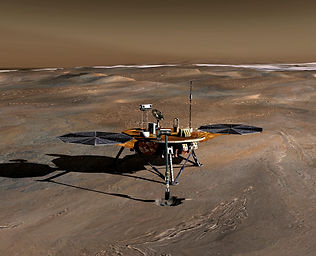
In just over a week`s time NASA`s Phoenix Lander is due to launch for Mars where it will probe the arctic landscape searching for conditions favourable for past or present life. UK scientists from Imperial College London and the University of Bristol have provided hardware and are involved in the science operations.
Friday's scheduled launch of NASA's Phoenix Mars Lander has been postponed by 24 hours. The two available launch times on Saturday 4 August are 10:26 am GMT (05:26 am EDT) and 11.02 am GMT (06:02 am EDT)
The spacecraft will start its journey onboard a Delta II rocket from Cape Canaveral, Florida. Phoenix will descend and land on the Red Planet’s northern plains, in the area known as Vastitas Borealis, in May 2008, where it will claw down into the icy soil. Once on the surface the scientists will have three months to complete their tasks before the Martian winter sets in and the solar panels no longer provide enough power to run the instruments.
Professor Keith Mason, Chief Executive of the Science and Technology Facilities Council, who support the UK involvement in the mission said, “Even though Mars has rovers on its surface and satellites remote sensing it from orbit it continues to intrigue and amaze us. By landing on the northern plains Phoenix will give us an insight into the icy world beneath, furthering our quest to find out whether conditions exist for past or present life on Mars."
Click Jupiter ->
